

The 2G/3G Sunset Is Approaching. Are You Ready?
Mobile network operators are accelerating the retirement of legacy 2G and 3G infrastructure to refarm spectrum for 4G/LTE and 5G. For many enterprises, this is less a “telecom upgrade” and more a business continuity event: a time-bound change that can disrupt field operations, safety systems, revenue workflows, and regulatory commitments if even a small population of devices is missed.
As telecommunications networks have evolved, the decommissioning of 2G/3G has become a complex migration that carries significant operational risk. Hidden IoT dependencies, distributed estates, multi-carrier footprints, and third-party managed devices make it easy for critical endpoints to slip through governance and asset-management processes—until they fail in production.
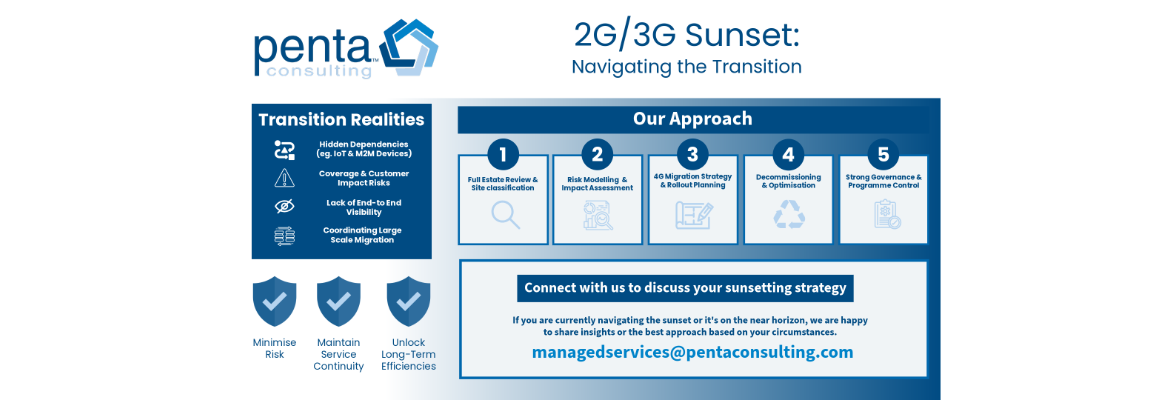
This article frames 2G/3G sunset readiness from a business perspective: what is changing, where enterprises are most exposed, and how a structured methodology reduces disruption while unlocking long-term efficiencies. It also outlines how Penta Consulting supports partners through these “Transition Realities” with a proven, 5-step approach designed to minimise risk and maximise return.
1) What the 2G/3G phase-out means for enterprises
The 2G/3G phase-out (often referred to as the “sunset”) is the staged shutdown of older radio access technologies across markets and carriers. Operators typically execute the change regionally and progressively (site by site and band by band), which means impact can appear uneven: one geography may fail weeks or months before a widely publicised “final date.” For businesses, this variability turns the sunset into an operational hazard—especially for mobile or roaming assets.
In practical terms, 2G/3G migration is not only about replacing a modem. It often requires revalidating end-to-end service: device firmware, APN/SIM profiles, carrier agreements, backend ingestion pipelines, alerting, security controls, and, critically, the field processes that keep service running while hardware is swapped.
2) Why 2G/3G sunset readiness is harder than it looks
Enterprises commonly underestimate their exposure because legacy connectivity is frequently “embedded” in places the business does not actively manage. Typical failure patterns include:
- Unknown device populations: IoT and M2M endpoints procured years ago and deployed across branches, vehicles, customer sites, or remote infrastructure.
- Third-party ownership: Security, facilities, or equipment vendors whose contracts include connectivity—yet device technology choices were never fully documented.
- Long hardware lifecycles: Industrial equipment, utility assets, and fixed installations designed for 7–15+ years of service, outliving network generations.
- Fragmented carrier footprint: Multiple operators across states/countries, each with different retirement schedules, coverage realities, and certification requirements.
- Application coupling: Devices that “phone home” to proprietary platforms where changing protocols or endpoints triggers integration and compliance work.
3) Business impact: where the risk concentrates
The most material risks tend to appear in operationally critical, widely distributed, or customer-facing environments. Common categories include:
- IoT and telemetry: Asset tracking, cold-chain monitoring, environmental sensors, building management systems, smart metering, remote condition monitoring, and industrial gateways.
- Transportation and fleet: Telematics units, ELDs, route optimisation, diagnostics, in-cab safety systems, and last-mile delivery devices that cross coverage boundaries.
- Safety and security: Intrusion and fire panels, lone-worker devices, elevator phones, emergency call boxes, and monitoring links where service continuity has life-safety implications.
- Payments and revenue workflows: Cellular POS terminals, kiosks, vending, ATMs, and unattended retail where connectivity loss creates immediate revenue leakage.
- Field service enablement: Workforce mobility, dispatch communications, and rugged devices that support SLAs and contractual outcomes.
The operational signature of a poorly managed sunset is rarely a single catastrophic failure. More often it is “distributed degradation”: pockets of outages, intermittent connectivity, increased truck rolls, breached SLAs, and escalating incident volume—followed by expensive, reactive remediation.
4) Transition realities: the technical and operational risks you must control
A successful transition is defined by risk control as much as technology selection. The most frequent risk domains in enterprise 2G/3G migration programs include:
- Service continuity risk: Cutover sequencing, coverage variability, and maintenance windows that collide with operational peaks.
- Estate risk: Incomplete inventories, untagged locations, and “orphan” endpoints with no clear owner.
- Supply-chain and field execution risk: Hardware lead times, technician capacity, site access constraints, and the logistics of swapping devices at scale.
- Security and compliance risk: SIM lifecycle management, identity, encryption posture, credential rotation, and audit trails—especially for regulated operations.
- Integration risk: Backend platform changes, data format differences, and event processing behaviours that alter analytics, alerts, or automation logic.
- Commercial risk: Carrier contract misalignment, roaming cost exposure, device certification requirements, and unexpected per-device recurring charges.
5) Choosing the “right” target connectivity: beyond a simple 4G/5G decision
While many endpoints can move to 4G/LTE or 5G directly, enterprise estates are diverse. A durable design typically blends connectivity types based on power, coverage, bandwidth, latency, and longevity requirements. Options may include:
- LTE Cat 1 / Cat 1 bis: Strong general-purpose option for many IoT devices without the cost/complexity of full 5G.
- LTE-M and NB-IoT: Lower power consumption and deep-indoor coverage for sensors and metering use cases (where carrier support and roaming constraints must be evaluated).
- 5G (including private 5G where appropriate): Higher throughput and performance headroom for advanced applications, sites with deterministic needs, or strategic modernisation initiatives.
- Redundancy patterns: Dual-SIM/dual-carrier, multi-path routing, or alternative bearers where the cost of downtime exceeds the cost of resilience.
“Best” is therefore business-contextual: it is the solution that meets service requirements under real coverage conditions, fits field realities, passes security/compliance controls, and stays supportable across the asset lifecycle.
6) A practical blueprint for enterprise migration
High-performing programs treat the sunset as a managed transformation—owned, governed, measured, and executed with disciplined change control. At a minimum, your approach should include:
- Inventory and dependency discovery: Build a defensible device and service catalogue, including ownership, location, criticality, carrier, firmware, and integration endpoints.
- Risk-based prioritisation: Triage by business criticality, safety impact, revenue impact, and lead time (including site access and vendor dependencies).
- Target architecture and standards: Define approved connectivity profiles, device standards, security baselines, SIM lifecycle processes, and monitoring requirements.
- Pilot and validation: Prove coverage and end-to-end behaviour in representative environments; validate alerting, data integrity, performance, and rollback options.
- Scaled deployment: Execute a wave plan with field readiness, spares, change windows, and operational comms—supported by accurate reporting.
- Decommission and optimisation: Retire old contracts and assets, close security exposures, remove legacy integrations, and tune recurring costs.
7) How Penta Consulting helps: a structured, 5-step approach
At Penta Consulting, we help partners navigate these Transition Realities with a structured, 5-step approach designed to minimise disruption and maximise long-term return. While each environment differs, the methodology remains consistent:
- Discover: Establish governance, identify stakeholders, and build a comprehensive view of the estate—including “hidden” IoT/M2M dependencies across vendors, sites, and business units.
- Assess: Quantify risk, define criticality tiers, validate carrier sunset timelines against operational geographies, and identify constraints (certification, compliance, site access, lead times).
- Design: Create the target connectivity and device strategy (4G/LTE, LTE-M/NB-IoT, 5G, resilience patterns), plus security and monitoring standards fit for enterprise operations.
- Execute: Run pilots, build the wave plan, coordinate supply chain and field services, manage change control, and drive scaled deployments with measurable outcomes.
- Optimise: Decommission legacy services, rationalise contracts and recurring costs, enhance observability, and institutionalise lifecycle management to prevent repeat exposure.
The result is a migration program that is repeatable, auditable, and operationally safe—reducing incident load while positioning the business to take advantage of modern network capabilities.
8) Quick readiness checklist for business leaders
- Do we have an accurate inventory of cellular-connected assets (including third-party managed systems)?
- Do we know which endpoints are still 2G/3G dependent and where they are deployed?
- Do we have a validated carrier timeline by geography (not just a global date)?
- Have we defined the target connectivity strategy (including longevity, security baseline, and resilience requirements)?
- Is there a funded, resourced execution plan with pilots, wave deployments, and reporting?
Conclusion
The 2G/3G sunset is approaching, and the primary enterprise risk is not the technology change itself—it is unmanaged dependencies. Organisations that treat this as a structured transformation can protect service continuity, reduce operational noise, and emerge with a more secure and efficient connectivity estate.
If this is something we can support you with or you’d like to find out more, please contact [email protected].